
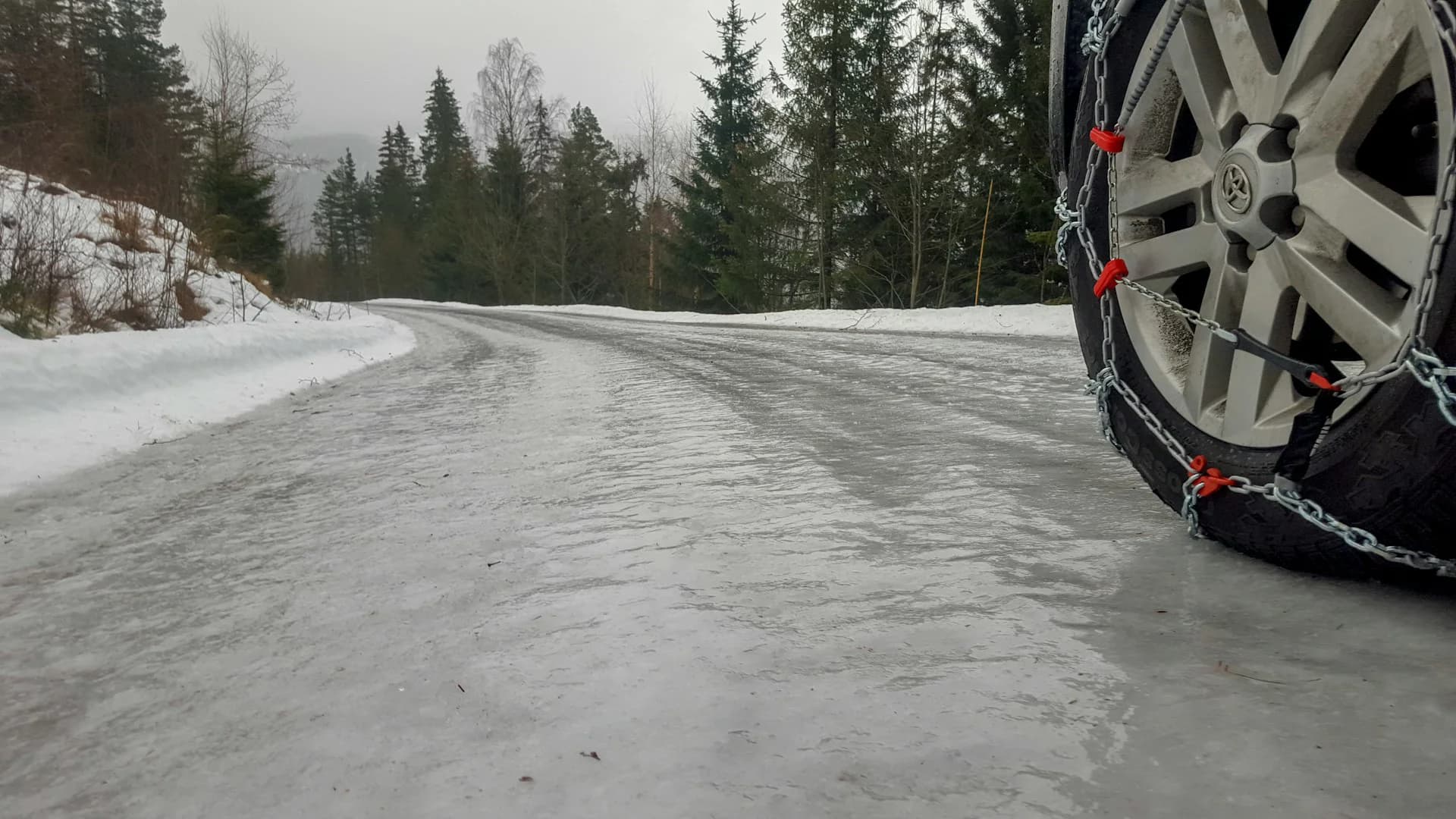
Austria's winter equipment law runs from 1 November to 15 April. Here's exactly when chains are required, where enforcement is heaviest, and what happens if you skip them.
The short answer
Between 1 November and 15 April, all motor vehicles driven on Austrian roads in wintry conditions (snow, slush, or ice) must use winter tyres OR all-season tyres marked M+S plus carry snow chains for one drive axle. On many alpine mountain passes, fitted chains are mandatory regardless of tyre type when blue chain signs are displayed. Each Austrian state's road authority enforces locally — the Tirol authority publishes daily advisories, and police roadside checks are common during heavy snow.
Tourists driving rentals get caught off-guard most often. If you're booking a private transfer instead, your driver carries chains as standard equipment from December through March, so this stops being your problem.
What the law actually requires
The Austrian Motor Vehicle Code §102 (4) covers winter equipment. From 1 November to 15 April, in wintry road conditions:
- Winter tyres marked M+S, M.S., or M&S with a tread depth of at least 4 mm (4 mm radial / 5 mm cross-ply)
- OR all-season tyres meeting the same M+S marking
- AND snow chains for at least one drive axle, carried in the vehicle (whether fitted or not)
Outside the date window, winter conditions still require seasonal-appropriate equipment, but the carry-chain rule lapses. Most rental companies in Austria switch tyres to summer specs around 16 April.
When you must actually fit the chains
Carry-rule and fit-rule are different. Chains stay in the trunk by default. You must fit them when:
- A round blue traffic sign with a tyre-and-chain symbol is displayed (mandatory chain zone)
- Police direct you to fit them at a roadside check
- The road authority issues an advisory for that specific road
The most chain-heavy roads in winter:
- B198 Arlberg — frequent enforcement, alternative to the toll Arlberg Tunnel
- B186 Ötztal — Sölden access, climbs to 1,377 m
- B188 Paznauntal — Ischgl + Galtür access
- Brenner Pass auxiliary roads (when A13 is congested)
- Felbertauern auxiliary B108 sections
- Großglockner Hochalpenstraße (closed in winter anyway)
What happens if you skip them
Police roadside checks during heavy snow events are routine. Penalties:
- Fine of €35–€5,000 depending on how the violation contributed to traffic flow or accident risk
- On-the-spot turn-back if your vehicle isn't properly equipped — you may be told to fit chains there or turn around
- Insurance complications in case of a winter accident if the vehicle wasn't legal
Rental companies' winter packages typically include chains; check the booking confirmation. Bring the rental's chain instructions — fitting them in falling snow at -5 °C is harder than the YouTube videos suggest.
What our drivers carry
Professional Austrian transfer drivers — including ours — carry winter-rated chains for the largest drive axle of the vehicle, sized to the specific tyre dimensions. Chains live in a dedicated trunk compartment from 1 November onwards. Drivers fit them when:
- A mandatory chain sign is displayed
- The day's road advisory recommends them for the selected route
- Fresh snowfall has reduced traction below the tyre's grip threshold
You won't see the chains unless conditions require them. AWD vehicles (our SUV and van tier) handle most winter conditions without fitted chains, but they're carried regardless — the law doesn't distinguish between AWD and 2WD.
Daily advisories — where to check
The most useful pre-departure check is your specific destination's road authority feed. The major ones:
- Tirol: Land Tirol Verkehr (publishes daily Sperren / Kettenpflicht updates)
- Salzburg: Land Salzburg Verkehr
- Vorarlberg: Land Vorarlberg Verkehrsdienst
- Federal level: ASFINAG for autobahns and Schnellstraßen
ÖAMTC (Austrian motoring club) and ARBÖ both run free advisory services in English and German.
A sanity check for first-time alpine drivers
If you've never fitted snow chains, do not learn during a Brenner Pass closure at 23:00 with snow falling. Either:
- Practice once in dry conditions before the trip starts
- Use a transfer service that handles the equipment for you
- Choose lower-altitude resorts (Mayrhofen, Kitzbühel) where chain enforcement is rarer than the Arlberg or Paznaun
Snow chains aren't difficult — they're inconvenient under stress. Five minutes' practice in a parking lot saves you from a 40-minute fumble in the dark on a mountain road.
FAQ
Do AWD or 4WD vehicles still need chains? Yes — Austrian law doesn't exempt AWD/4WD from the carry rule. They simply hold off on fitting chains longer than 2WD vehicles. AWD plus winter tyres handles most conditions; chains stay reserved for mandatory-chain-zone signs or extreme snowfall.
What about studded tyres? Studded tyres are legal in Austria from 1 October to 31 May, but carry restrictions: max 100 km/h on motorways, max 80 km/h on other roads, and a "studded tyre" sticker on the rear of the vehicle. Most rentals don't offer them — winter M+S tyres are standard.
Do I need chains for transfers from Salzburg or Vienna airports? Salzburg-region routes use the A10 Tauern Autobahn — well-maintained, chains rarely fitted on motorway sections. Vienna routes are flat-lander territory once you're east of Wörgl. Chain enforcement applies on the final mountain leg if your destination is alpine, but on the bulk of the route from VIE or SZG, chains stay packed.
What's the fine if my rental car fails a check? €35 minimum for missing equipment; up to €5,000 if the violation contributed to a hazard. Police generally offer a fit-or-turn-back option for honest tourists rather than a max-fine on the spot.